


Japans Security Role in the Pacific Theatre
- Joss Millward

- Mar 8, 2023
- 11 min read
In the wake of its low-profile presence in cold war security order, Japan has entered the 21st century justifiably keen to be one of the leading forces behind constructing contemporary security architecture and order within East Asia. In this essay I will begin by zooming into Japan’s heavy involvement in regional institutions and treaties serving to establish a framework and architecture on which to manage issues such as the rise of China as a military power, the volatile nature of missile development on the Korean peninsula and piracy amongst other dilemmas. I will then look to Japan’s hand in the construction of a Regional Security Multi-lateralism (RSM) order and how analysts such as Goh, Midford and Soeya all describe a Japan that is focusing on the aims of a socialised China, regional peace, reassurance, and economic prosperity leading the way in cooperation with other states so as to avoid isolation and domination. I will present the argument that Japan is a massive player in constructing both regional security architecture and order.
Construction of Regional Security Architecture
Though often overlooked given the well-known article 9 of its constitutional opposing of war as a resolution to disputes, I will look at how through enabling US military presence in the region, high investment in its own missile defence systems alongside possessing a capable navy and increasing its military spending, Japan’s efforts in security architecture are not to be dismissed. Couple this military activity with its active role in institutional frameworks we see how Japan is one of the most significant players in the region. To begin with, given the sheer scale of the US as a global military power Japan’s role in hosting the largest contingent of US military personnel of any country worldwide is crucially important (United States Department of Defence, 2021). Having been a sovereign country for decades now, no longer under the yoke of a Cold war global order, this state of affairs clearly shows how Japan is looking to be the key spoke to America’s hub through its own agency. It further implies the desire to be involved in the “preparedness”, global “partnerships” and regional “networking” of the US Indo-Pacific strategy as formulated by former acting secretary of defence Shanahan in 2019 (United States Department of Defence). Beyond America’s aims for the Indo-Pacific region, Japan’s enabling of US presence also helps address its concerns of a nuclear-capable North Korea and a China seeking expansion into the Western Pacific as outlined in a talk given to World Affairs by Smith (2019), a Council on Foreign Relations Senior Fellow for Japan Studies.
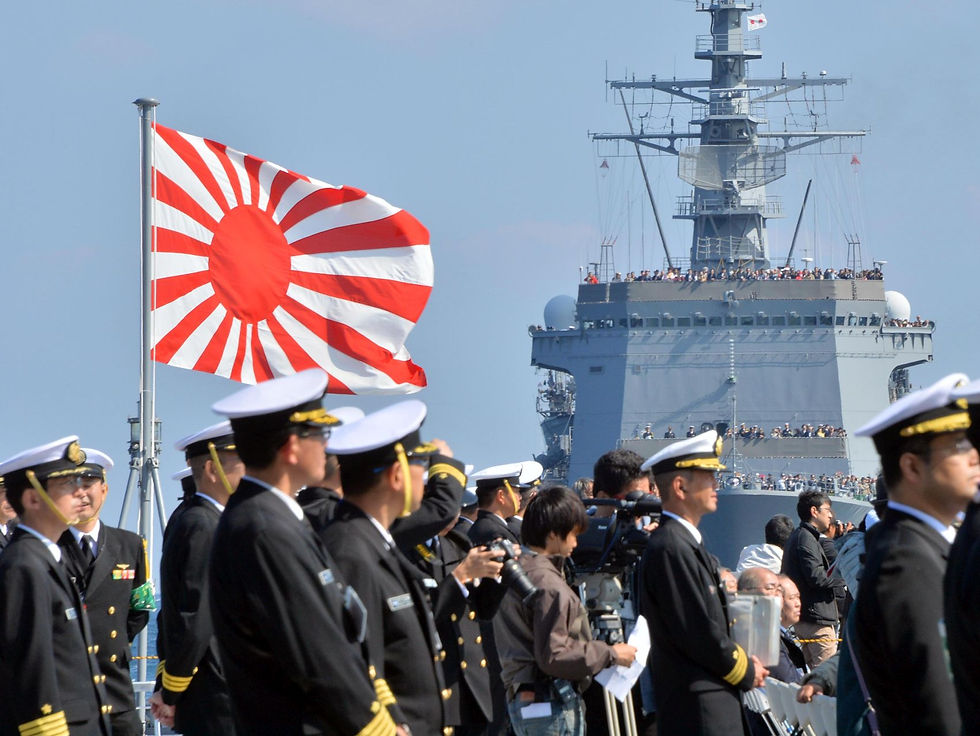
Moving on to Japan’s own military capabilities, Smith (2019) was keen to stress that Japan is currently in a “rearmed” state, having invested heavily into missile defence systems, possessing what Smith describes as the “best navy in Asia”. Though this claim may be questionable given the sheer scale of China’s own navy, the size and advanced nature of Japan’s navy makes it certainly one of the top maritime powers in the region with or without American presence as Mizokami (2021) and Smith (2019) noted. Smith (2019) goes on to say that 2022 will signal the end of a 5 year, 2% increase in Japanese military spending, a significant display of Japan’s desire to maintain domestic defensive security architecture. Following from military spending and development, the 21st century ushered in new approaches to deployment. Both Smith (2019) and Midford (2020) describe the post 1991 shift, following foreign critique of its non-engagement in the first Gulf war Japan provided assistance to US forces in Iraq in the wake of 9/11, going on to send ground forces to aid reconstruction there also, furthermore Japan has sent its navy to assist anti-piracy measures in the Gulf of Aden. While these are not examples of regional security measures they can be used as an indication of a change in attitudes that, coupled with the forementioned advancement of technology can further cement the view that Japan will prove to be a growing presence in East Asian security. However, it must also be noted that public opinion and even the more conservative-leaning contingents of Japanese government agree article 9 is to be maintained indefinitely, giving little chance of Japan enacting offensive measures any time soon (Smith, 2019). This militarised but self-defensive stance that Japan is maintaining for itself within East Asian security architecture can be proven to be notable given China’s high levels of development into “asymmetrical weapons” with the aim of keeping both US and crucially, Japan at an arm’s length (Smith, 2019). Should Japan not have been a leading force in security architecture, China would not feel the need to address it within the same breath as such an explicitly active militarised state as the US.
Moving on to Japan’s involvement in the institutional facets of East Asian regional security architecture, one of the ways to highlight its role is to contrast pre- 21st century to 21st century in regards to institutional activity. Midford (2020) correctly highlights Japan’s relatively isolated position during the Cold war with the exception of US interaction, even its activity within RIMPAC was constrained to only bi-laterally interacting with the US. Furthermore, after the forementioned pivot in 1991, Japan experienced teething issues in its new self-ascribed leadership role in RSM (Japan helped form the ASEAN-ARF despite US opposition) these included ASEAN deciding to include the non-like-minded states of China, Russia, and India in the ASEAN-PMC against Japan’s wishes (Midford, 2020). Furthermore, Japan’s bid to form another like-minded ASEAN forum through the Hashimoto doctrine was denied. Both these incidents perhaps signalling a Japan not-yet affirmed in its regional leadership role. Following from the turn of the century however, we see Japan continuing down the route of heavy institutional involvement, it helped establish the East Asia Summit in 2005 (Midford, 2020) (again against US wishes, displaying not so much anti-American sentiment or even a rejection of America’s forementioned three-pronged Indo-Pacific strategy, but the reality that a 21st century Japan is willing to counter US interests in favour of forming its own interpretation of regional security architecture). It went on to use the ARF to negotiate the ReCAAP, a regional, multi-lateral agreement for fighting piracy in 2006, also increasing involvement of foreign ministries within the ARF and support in the creation of the Expanded ASEAN Maritime Forum and the Trilateral Cooperation Secretariat (Midford, 2020). Midford (2020) makes the strong case that Japan is involving itself so heavily into institutional multi-lateralism to “create a voice for itself” and stand firm as a self-governed state in the presence of a rising China, using RSM to secure individual bi-lateral partnerships with other nations such as a Vietnam, Indonesia, and the Philippines. I would argue this is a justified move given China’s position as the largest import source for all three of these smaller states (WTO, 2022).
Construction of a Regional Security Order
Having addressed the role Japan has played in constructing regional security architecture, I will now look to Japan’s forming of a security order within the region. Goh (2011) outlines three key strategies for the region as a whole, going into depth on how Japan is a crucial element in each, I will further look at Soeya (2020) and Midford’s (2020) interpretations of Japan’s own intentions of instilling an “inclusive”, “rule-based regional order, offering “reassurance” to its neighbours. Looking to Goh’s (2011: 887-888) analysis first, she argues that in the wake of the pre-21st century “uni-polar order” (whose raison d'être was the US attempt to stifle the influence of those on the opposing side of the Cold war), the region now holds three implicit strategies or aims. The first of these strategies Goh (2011: 888-892) claims is the maintaining of US military presence in the region, this is arguably true as South Korea is keen for the US to continue its presence in support of signalling to North Korea that it would face dire consequences if violence broke out in their conflict that remains ongoing (Kim, 2018). Taiwan also is keen for US presence to remain given China’s continued incursions into its airspace, the Philippines has also requested in 2019 the support of the US 7th fleet to counter Chinese movements in the south China sea (Guarco, 2019, Hale, 2022). Given regional support for America’s presence, Japan then is indeed essential in that the 7th fleet is head quartered in Yokosuka, Japan, coupled with multiple other US military bases hosting the largest faction of overseas US military forces as already mentioned.
Goh (2011: 888, 892-897) lists socialising China as the second of the region’s strategies. A China more aligned with the political, economic, and social values of its neighbours is seen as a state less likely to be a threat militarily speaking, a point of utmost importance given frayed relationships over island disputes as Smith (2019) notes. Goh (2011: 893) puts this socialisation as allowing China to maintain its significant place as a regional power in exchange for constraints on that power. Instances of this socialisation include a defence minister’s dialogue between the two states in 2003 and “high level strategic dialogue” on their differing views of the south China sea in 2005 (Goh, 2011: 894). Japan has used its active role in regional institutions-that we have touched on already-to facilitate Chinese socialisation. The ARF which Japan helped form was the means by which China published its first defence white paper and China went on to be the first “external power formally to accede to ASEAN's Treaty of Amity and Cooperation in 2003” (Goh, 2011: 894). It’s important to note that Japan’s role in socialising China did exist prior to the 21st century, being the leader in efforts to rehabilitate Japan after the Tiananmen square massacre, economically and diplomatically speaking (Goh, 2011: 893).

Goh (2011: 888, 897-900) lastly gives regionalism with the aim of peace as the third regional strategy, states in the region operating as a collective with shared goals and norms similar to that of the European Union. Much of the push for regionalism can again be attributed to institutions such as ASEAN, deciding to include the ASEAN+3 and the even wider collective of states for the East Asian Summit (Midford, 2020). Beyond Japan’s extensive support for these institutions, Japan worked to widen its definition of East Asia to include India in 2005, not to mention Japan in 2020 having the most inclusive interpretation of the concept of the ‘Indo-Pacific’, stretching from the East coast of Africa across to the West coast of the Americas (Ministry of Foreign Affairs of Japan, 2019). This signals a wish for Japan to recruit-as it were-as many states as it can, into a community of nations not afraid to band together on issues. This would appear to make sense as Midford (2020) describes Japan’s use of RSM to avoid isolation and form a potential base of balancing should China continue to pose a threat. Midford (2020) goes on to highlight the point of reassurance, he notes that a cold war Japan used its isolation as reassurance given regional wariness in the wake of its domination during the Second World War, but in the current age its Japan’s multi-lateralism and reaching out in its diplomacy that is a mode of reassurance. This signals a shift in trust of surrounding states and respect of Japan as a figurehead in the region’s security order.
Japan’s own Indo-Pacific ‘vision’ gives an insight into its role in regional security order. The first point in this vision is the establishing and promotion of rule of law and free trade, this can fit neatly into the second and third of the regional strategies listed by Goh (2011) that I have mentioned (Soeya, 2020). The second point of the vision is the pursuit of economic prosperity, this could be seen as an aim of the third regional strategy of regionalism, indeed Goh (2011: 899) mentions Japan’s shaping of the Chiang Mai Initiative and support for fund pools for use of regional states (Soeya, 2020). Last of the points within Japan’s Indo-Pacific Vision is the commitment to peace and prosperity. Of the three, this relates most to regional security order, security issues at present include piracy in areas such as the Malacca straight, tension over the Taiwan strait, missile threats from the Korean peninsula and Japanese territorial disputes with China, Russia, and Korea (Rahman, 2021, Ryall, 2021, Soeya, 2020). Japan’s build-up of its self-defence forces, participation in anti-piracy missions and institutions, widespread diplomacy with neighbouring countries through institutions and treaties, can be seen then as ample evidence of commitment to securing peace. An evaluative point however must be given to certain Japanese activities that are proving inflammatory to its relationship with China. Goh (2011: 900) notes that Japan’s new role in the 21st century, free of any discernible American suppression and becoming militarily proficient on its own, to an external observer it appears to undermine a reason for America’s presence in the region. This concerns China as Japan is now a military partner of the US as opposed to being a constrained subject. Furthermore, Solis (2020: 129) notes that Japan in recent times may be leaning further into American relations over China’s arguably flawed approach to Covid management and its violation of the “one country, two systems approach to Hong Kong in 2019. Goh (2011: 900) notes in a suitable ending that Japan has not reassured China that its “revised alliance and Japan's remilitarization are not targeted in part at China.”. So, we see that the order Japan is helping to instil, combines being a figurehead in maintaining US presence, conducting institutional affairs to socialise China, and developing regionalism whilst also positioning itself it seems, to be able to better face a confrontive China should those socialisation attempts fail.

Conclusion
In conclusion then I initially addressed Japan’s role in constructing regional security architecture through its often overlooked yet significant investment in its military coupled with the enthusiasm for hosting large numbers of US forces. I further looked at Japan’s influence in creating and sustaining regional institutions, providing a framework for networked security architecture between states. In the second part of the essay, I addressed Japan’s role in creating the regional security order, how Japan changed from a state who’s lack of involvement in regional affairs had proved reassuring to its neighbours, to a state who is currently using its outreach in regionalism and institutions as a new form of reassurance. We see a contemporary Japan seeking multi-lateralism as a base for further, separate bi-lateral alliances, crucially avoiding its isolation in the presence of a looming, expansive China. Whilst Japan’s preponderance for peace and efforts to socialise China display a hope for peaceful diplomacy, the military build-up, support of American presence and close networking with smaller surrounding states signals soft balancing, so as not to be pushed over should conflict with China arise. Japan then is a fascinating and extremely pro-active player in the construction of both architecture and order of security in the region.
Source
Goh, E. (2011). How Japan matters in the evolving East Asian security order. International Affairs , pp. 887-902.
Guarco, I. (2019, July 18). Is Duterte Really Asking for U.S. Aid Against China? Foreign Policy, available online at: https://foreignpolicy.com/2019/07/18/is-duterte-really-asking-for-u-s-aid-against-china/ , accessed 21st April 2022.
Hale, E. (2022, February 4). Taiwan Foreign Minister Calls US Help Critical to Deterring War with China. VOA News, available online at: https://www.voanews.com/a/taiwan-foreign-minister-calls-us-help-critical-to-deterring-war-with-china-/6456995.html , accessed 3rd May 2022.
Kim, C. (2018, May 2). South Korea says it wants U.S. troops to stay regardless of any treaty with North Korea. Reuters ,available online at https://www.reuters.com/article/us-usa-southkorea-northkorea-idUSKBN1I305J , accessed 24th April 2022
Midford, P. (2020, October 7). Japan's Leadership in East Asian Security Multilateralism. Retrieved from youtube.com: https://www.youtube.com/watch? v=kkmiPg8065Y&t=3129s&ab_channel=TheSwedishInstituteofInternationalAffairs-Utrikespolitiskainstitutet%28UI%29, accessed 20th April 2022.
Ministry of Foreign Affairs of Japan. (2019, November 21). "Free and Open Indo-Pacific. Retrieved from mofa.go.jp: https://www.mofa.go.jp/files/000430632.pdf , accessed 25th April 2022.
Mizokami, K. (2021, July 15). Japan's Navy Is a Lot More Powerful Than You Realize. The National Interest. Available online at: https://nationalinterest.org/blog/reboot/japans-navy-lot-more-powerful-you-realize-189542 , accessed 20th April 2022
Rahman, M. (2021, July 19). The Persistence of Piracy and Armed Robbery against Ships in the Straits of Malacca and Singapore. Modern Diplomacy, Available online at: https://moderndiplomacy.eu/2021/07/19/the-persistence-of-piracy-and-armed-robbery-against-ships-in-the-straits-of-malacca-and-singapore/ , accessed 24th April 2022
Ryall, J. (2021, February 26). Japan’s territorial disputes: China, South Korea, Russia and more. This Week In Asia, available online at: https://www.scmp.com/week-asia/politics/article/3123219/japans-territorial-disputes-china-south-korea-russia-and-more , accessed 21st April 2022
Smith, S. (2019, November 15). Sheila Smith: The Politics of Japan’s Military Power and East Asian Security. Retrieved from youtube.com: https://www.youtube.com/watch?v=xAIshFxr6VY&ab_channel=WorldAffairs , accessed 21st April 2022.
Soeya, Y. (2020, January 22). Japan and the Indo-Pacific: from strategy to vision. Australian Strategic Policy Institute: The Strategist. Available online at: https://www.aspistrategist.org.au/japan-and-the-indo-pacific-from-strategy-to-vision/ , accessed 19th April 2022
Solis, M. (2020). Th Underappreciated Power: Japan after Abe. Foreign Affairs, pp. 123-132.
United States Department of Defence . (2019). Indo-Pacific Strategy Report.
United States Department of Defence. (2021, December 31). Number of Military and DoD Appropriated Fund (APF) Civilian Personnel. Retrieved from dwp.dmdc.osd.mil: https://dwp.dmdc.osd.mil/dwp/api/download? fileName=DMDC_Website_Location_Report_2112.xlsx&groupName=milRegionCountry, accessed 28th April 2022.
WTO. (2022). Trade Profiles. Retrieved from www.wto.org: https://www.wto.org/english/res_e/statis_e/trade_profiles_list_e.htm , accessed 28th April 2022.


Comments